Raptor Electric LLC | Aurora, Colorado
Your Panel Isn’t Broken. It’s Full.
There’s a difference, and understanding it will save you a lot of frustration.
Most homeowners assume that if the lights turn on, the electrical panel is doing its job. Then they try to add something — an EV charger, a hot tub, a heat pump, a finished basement — and an electrician tells them no. That’s usually the first time anyone mentions the panel at all.
Here’s what’s actually happening. A 100-amp electrical service was the residential standard across Colorado for decades. It was sized for a house with one television, a gas range, no central air conditioning, and certainly no vehicle plugged into the garage overnight. That panel isn’t defective. It’s doing exactly what it was designed to do. The problem is that the house it was designed for no longer exists.
If you own a home in Aurora, Lakewood, or any of the older Denver Metro neighborhoods, there’s a reasonable chance you’re running a 2026 household on a 1978 electrical service.
Six Signs Your Panel Has Reached Its Limit
These are the situations we encounter most often on service calls across the Denver Metro. If more than one sounds familiar, your panel is likely at capacity.
1. Somebody already told you no
You wanted an EV charger, a hot tub, an air conditioning upgrade, or a dedicated workshop circuit — and a contractor told you the panel couldn’t support it.
That isn’t an upsell. Before adding any significant load, a licensed electrician performs a load calculation: a formal assessment of your home’s total electrical demand measured against what your service can safely deliver. When the math doesn’t work, adding the circuit anyway would be both a code violation and a genuine safety hazard.
2. Breakers trip when appliances overlap
The air conditioner and the clothes dryer running together. The microwave and a space heater on the same morning. If you’ve started mentally scheduling your appliances to avoid tripping a breaker, that’s not a quirk of an old house — that’s your panel telling you it’s operating at its ceiling.
A breaker tripping is the system working correctly. It’s an intentional safety mechanism interrupting a circuit that’s drawing more current than it should. Repeated tripping means you’re hitting that limit routinely.
3. There are no open breaker slots left
Open your panel door and look. If every slot is occupied, you have no room to add circuits without modification.
Also look for tandem breakers — narrow breakers installed two-to-a-slot to squeeze in additional circuits. They have legitimate uses, but when a panel is full of them it usually means somebody was working around a capacity problem rather than solving it. Many panels also have a manufacturer limit on how many tandems they’re rated to accept.
4. Lights dim when large appliances start up
The air conditioner compressor kicks on and the lights flicker for a moment. The refrigerator cycles and you notice it across the room.
This is voltage drop under load. When a motor starts, it briefly draws several times its normal running current. A service with adequate capacity absorbs that surge without a visible effect. A service near its limit doesn’t. Occasional, very slight dimming can be normal — but if it’s consistent and noticeable, it’s worth having evaluated.
5. You have a fuse box, or a panel older than you are
Fuse boxes are still in service in older Colorado homes. So are certain panel brands manufactured decades ago that have since developed reputations for reliability concerns — Federal Pacific Electric Stab-Lok and Zinsco are the two that come up most frequently in this region.
If you have one of these, it’s worth knowing. Some insurance carriers ask about panel type on applications or during renewal, and some home inspectors flag them during a sale. Whether or not yours needs immediate replacement is a question for a licensed electrician who can inspect it in person — but it shouldn’t be an unknown.
6. You’re planning anything electrical in the next few years
EV charger. Solar. Heat pump. Finished basement. Accessory dwelling unit. Detached garage or workshop. Whole-home generator.
Every one of these projects begins with the same question: what can the service carry? Homeowners frequently discover the answer partway into a renovation, when the budget is already committed. Finding out early is significantly cheaper than finding out late.
Why This Is Coming Up More Often in Colorado
Three trends are converging in the Denver Metro at the same time.
Electric vehicles. A Level 2 charger typically requires a dedicated 40 to 60 amp circuit. On a 100-amp service, that single addition can represent more than half your total capacity.
Electrification of heating and cooling. Heat pumps, mini-splits, and electric water heaters are replacing gas equipment in homes across the region. Each transfers demand from the gas meter to the electrical panel.
Older housing stock. Large portions of Aurora, Lakewood, and central Denver were built between the 1950s and the 1980s. Many of those homes still have their original service, and many have had additional loads added incrementally over the decades without anyone stepping back to reassess the total.
Individually, none of these is a problem. Together, they’re why panel capacity has become one of the most common conversations we have with homeowners.
What a Panel Upgrade Actually Involves
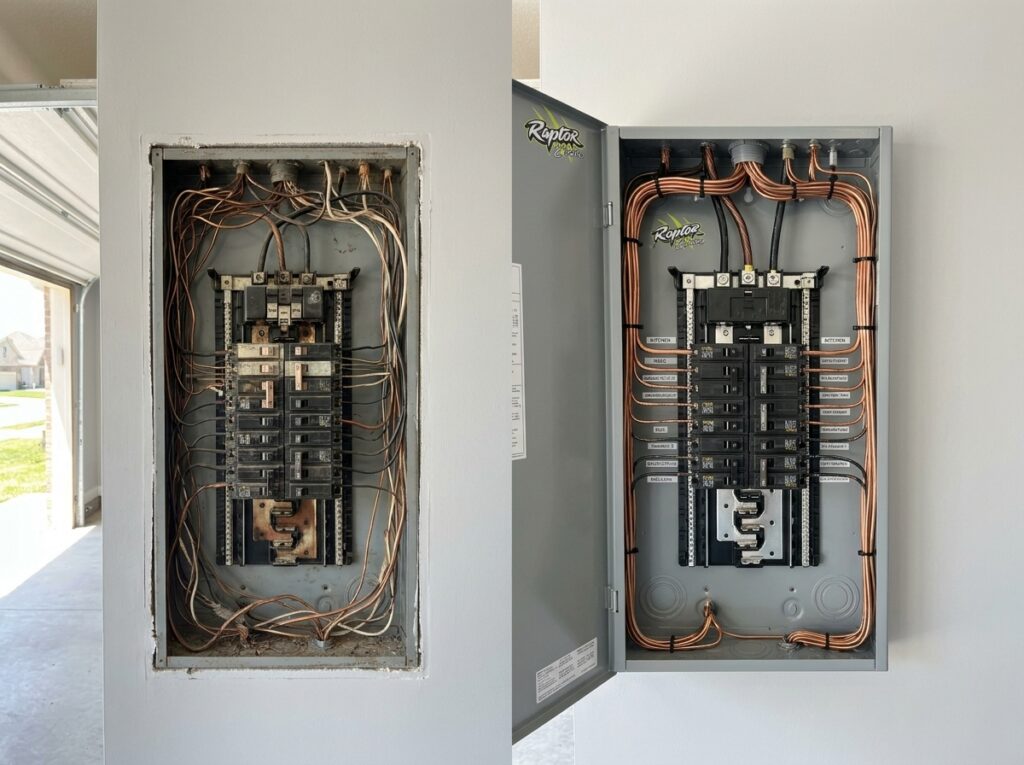
A service upgrade from 100 to 200 amps is a full-day project for most residential homes. Here’s what it includes:
- Load calculation to confirm the appropriate service size for your home
- Permit application with your local jurisdiction
- Coordination with the utility to disconnect and reconnect service
- New panel and breakers, sized and labeled properly
- New service entrance conductors and meter socket where required
- Grounding and bonding brought up to current code
- Inspection by the local authority before the work is signed off
Expect your power to be off for several hours during the changeover. Expect a permit and an inspection — if a contractor offers to skip either one, that’s a reason to call someone else. Unpermitted electrical work can create problems when you sell the home and can complicate an insurance claim.
What you actually gain isn’t just a bigger number on the panel door. It’s the ability to say yes to the next thing you want to do to your house, without starting the conversation over from the beginning.
What You Can Check Yourself, Safely
There’s useful information you can gather without any risk.
Open the panel door — the outer door with the directory on it, not the inner cover. Count how many slots are empty. Look for narrow tandem breakers doubled into single slots.
Find the main breaker at the top of the panel. The number printed on it is your service size: 100, 150, or 200.
Read the directory and note whether it’s legible and accurate, or handwritten and outdated.
Note any patterns — which appliances trip breakers, whether lights dim, whether any outlet or the panel itself ever feels warm.
Do not remove the inner cover. The area behind it contains energized conductors that remain live even with the main breaker switched off. Everything above gives an electrician a useful starting picture without putting you anywhere near live components.
If an outlet, a switch, or the panel itself is warm to the touch, or if you smell anything burning, stop and call a licensed electrician right away. That isn’t a capacity question — that’s an immediate safety issue.
The Bottom Line
A 100-amp panel isn’t dangerous simply because it’s 100 amps. Plenty of Colorado homes operate on one safely and will continue to.
The question isn’t whether your panel is failing. It’s whether it can carry the house you actually live in — and the house you’re planning to have in five years. If you’ve been told no, if you’re scheduling appliances around your breakers, or if you’re considering an EV charger or a renovation, that’s worth knowing before you commit to anything else.
Get a Panel Evaluation
Raptor Electric LLC is a licensed and insured electrical contractor based in Aurora, Colorado. We perform load calculations and panel evaluations for homeowners throughout Aurora, Denver, Centennial, Lakewood, Castle Rock, and Parker.
We’ll tell you honestly what your service can support — including when the answer is that you don’t need an upgrade yet.
Call for a free panel evaluation.
Raptor Electric LLC — Licensed. Insured. Colorado-based.